
It is easy to say athletes are faster, stronger, and more explosive than they used to be.
It is harder to say how much better.
Track and field gives us one of the cleanest ways to measure that question. A 100m race is still 100m. A high jump bar is still a high jump bar. A discus still lands where it lands. The events are not perfectly unchanged, because surfaces, shoes, training, competition depth, and athlete access have changed, but the scoreboard is unusually clear.
So we compared the world record that was standing on January 1, 1976 with the current listed world record as of May 20, 2026.
The result is not one simple story. Some records barely moved. Some moved a lot. Some moved because athletes became better. Some moved because the sport around the athlete became better.
For running events, improvement means the record got faster. For jumps and throws, improvement means the record got higher or farther. Historical hand-timed sprint marks and pending road-record ratifications should be read with that context.
The comparison
This table uses 10 events across men's and women's track and field: sprints, middle distance, marathon, jumps, and throws.
| Event / category | 1976 standing WR | Current WR | Change | % change |
|---|---|---|---|---|
| Men 100m | 9.95Jim Hines, 1968 | 9.58Usain Bolt, 2009 | 0.37s faster | 3.7% |
| Women 100m | 10.8Renate Stecher, 1973 | 10.49Florence Griffith Joyner, 1988 | 0.31s faster | 2.9% |
| Men 200m | 19.83Tommie Smith, 1968 | 19.19Usain Bolt, 2009 | 0.64s faster | 3.2% |
| Women 200m | 22.21Irena Szewinska, 1974 | 21.34Florence Griffith Joyner, 1988 | 0.87s faster | 3.9% |
| Men 400m | 43.86Lee Evans, 1968 | 43.03Wayde van Niekerk, 2016 | 0.83s faster | 1.9% |
| Women 400m | 49.9Irena Szewinska, 1974 | 47.60Marita Koch, 1985 | 2.30s faster | 4.6% |
| Men 800m | 1:43.7Marcello Fiasconaro, 1973 | 1:40.91David Rudisha, 2012 | 2.79s faster | 2.7% |
| Women 800m | 1:57.5Svetla Zlateva, 1973 | 1:53.28Jarmila Kratochvilova, 1983 | 4.22s faster | 3.6% |
| Men 1500m | 3:32.2Filbert Bayi, 1974 | 3:26.00Hicham El Guerrouj, 1998 | 6.20s faster | 2.9% |
| Women 1500m | 4:01.4Ludmila Bragina, 1972 | 3:48.68Faith Kipyegon, 2025 | 12.72s faster | 5.3% |
| Men Marathon | 2:09:12Derek Clayton, 1969 | 1:59:30Sabastian Sawe, 2026 | 9:42 faster | 7.5% |
| Women Marathon | 2:38:19Jacqueline Hansen, 1975 | 2:09:56Ruth Chepngetich, 2024 | 28:23 faster | 17.9% |
| Men High jump | 2.30mDwight Stones, 1973 | 2.45mJavier Sotomayor, 1993 | 0.15m higher | 6.5% |
| Women High jump | 1.95mRosemarie Ackermann, 1974 | 2.10mYaroslava Mahuchikh, 2024 | 0.15m higher | 7.7% |
| Men Long jump | 8.90mBob Beamon, 1968 | 8.95mMike Powell, 1991 | 0.05m farther | 0.6% |
| Women Long jump | 6.99mHeide Rosendahl, 1970 | 7.52mGalina Chistyakova, 1988 | 0.53m farther | 7.6% |
| Men Shot put | 21.82mAl Feuerbach, 1973 | 23.56mRyan Crouser, 2023 | 1.74m farther | 8.0% |
| Women Shot put | 21.60mNadezhda Chizhova, 1973 | 22.63mNatalya Lisovskaya, 1987 | 1.03m farther | 4.8% |
| Men Discus | 69.08mJohn Powell, 1975 | 75.56mMykolas Alekna, 2025 | 6.48m farther | 9.4% |
| Women Discus | 69.90mFaina Melnik, 1975 | 76.80mGabriele Reinsch, 1988 | 6.90m farther | 9.9% |
The biggest jump is not in the 100m
The 100m is the event most people think about first, but it is not where the biggest percentage gains happened.
The men's 100m record moved from 9.95 to 9.58, a 3.7% improvement. That is enormous in a race decided by hundredths, but it is still a small percentage change. The women's 100m record moved from a hand-timed 10.8 to 10.49, a 2.9% improvement.
Compare that with the marathon. The men's mark improved from 2:09:12 to Sabastian Sawe's 1:59:30, which World Athletics listed as a world record pending ratification after the 2026 London Marathon. The women's mark improved from Jacqueline Hansen's 2:38:19 road best in 1975 to Ruth Chepngetich's 2:09:56 in 2024.
That is the clearest example of the sport changing around the athlete: deeper professional fields, faster courses, better pacing, better fueling, more global participation, and a new era of racing shoes.
Some records are old because they were extraordinary
Not every old record means the event stopped progressing.
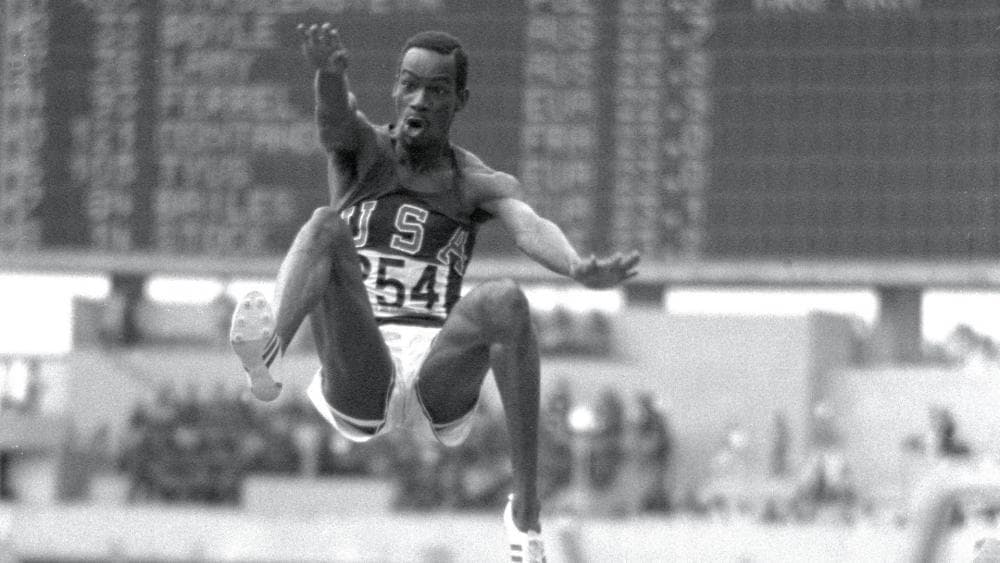
Bob Beamon's 8.90m long jump from 1968 was so far ahead of its time that Mike Powell only moved the world record by 5cm in 1991. The chart makes that obvious: men's long jump has the smallest percentage change in the sample.
The same pattern appears in a different way in women's throws. The current women's discus record, 76.80m by Gabriele Reinsch, was set in 1988. The women's shot put record, 22.63m by Natalya Lisovskaya, was set in 1987. Those marks still stand, which tells us that record progress is not a smooth line. It can surge, freeze, and then wait decades for the next athlete, technique, or competitive environment to catch up.
Women's records also reflect opportunity
The women's side of the table is not only a physiology story. It is also an access story.
In 1976, women's track and field was still developing toward the program we know now. The women's marathon was not added to the Olympics until 1984. The women's triple jump and pole vault came much later. That means comparing "1976 vs today" is clean for some events and messier for others.
That is why the main table avoids events that did not have a stable women's world-record lineage in 1976. Even so, the pattern is clear: when participation, funding, event access, and professional competition expand, the record book changes.
Why athletes improved
World records are not just a measurement of one athlete's body. They are a measurement of the full system around that athlete.
The last 50 years changed that system in several ways:
- Training became more specific. Coaches can now plan speed, power, recovery, and technical work with more precision.
- Talent pools became deeper. More athletes from more countries can specialize earlier and compete professionally.
- Surfaces and equipment improved. Synthetic tracks, throwing circles, poles, shoes, and apparel changed what is possible.
- Sports science became normal. Strength training, nutrition, biomechanics, altitude work, recovery, and medical support are now part of elite preparation.
- Video made technique more visible. Athletes and coaches can review positions, rhythm, angles, and timing that were previously too fast to see.
The lesson for coaches is not that every athlete should chase world-record change. The lesson is that small, measured improvements compound when you can see exactly what changed.
What this means for everyday athletes
Most athletes will never move a world record. That is not the point.
The useful lesson is that improvement is measurable when the measurement is consistent. If a sprinter's first three steps get lower and more powerful, that can be seen. If a jumper's takeoff angle changes, that can be seen. If a thrower is releasing earlier or later, that can be seen.
At the elite level, the record book captures 50 years of change.
At the athlete level, video captures the same idea frame by frame: what happened, what changed, and what needs to change next.
Sources and notes
Current world records and recent ratification notes were checked against World Athletics records, World Athletics athlete profiles and reports, including their reports on Sawe's 1:59:30 marathon, Kipyegon's 3:48.68 1500m, Mahuchikh's 2.10m high jump, Crouser's 23.56m shot put, and Alekna's 75.56m discus.
Historical 1976 baselines were cross-checked against World Athletics/IAAF record progression material and event progression references. The women's marathon baseline uses the leading pre-1976 road mark because the event was not yet part of the Olympic or World Championships program.
Ready to get started? Download KineVision today from the App Store and rediscover the power of professional video analysis.
Comparing coaching apps? See KineVision vs OnForm, KineVision vs Coach's Eye, KineVision vs Dartfish, or KineVision vs CoachNow.